
Pipe fittings rarely get the spotlight, but a single mismatched tee, elbow, or hex nipple can turn into a leak point that undermines an entire piping system. Two connection methods dominate industrial stainless steel piping: threaded and welded fittings. Understanding when to use each — and what to look for in fitting quality — helps engineers, contractors, and distributors avoid costly rework.
What Are Pipe Fittings, and Why Do They Matter?
Pipe fittings connect, branch, reduce, or redirect sections of pipe. Common types include:
- Tees — branch a line into two directions
- Elbows — change the direction of flow, typically 45° or 90°
- Hex nipples — connect two threaded pipe sections in a straight line
- Unions — allow pipe sections to be joined and disconnected without cutting, useful for maintenance access
Every fitting in a system is a potential leak point, which is why connection method and manufacturing quality matter just as much as the fitting’s basic geometry.
Threaded Fittings
Threaded fittings connect using NPT or BSP threads, tightened directly onto matching pipe threads without welding equipment.
Advantages
- Fast installation — no welding equipment, gas, or curing time needed on site
- Easy disassembly — ideal for systems requiring periodic maintenance or reconfiguration
- Lower installation cost — less skilled labor and equipment required compared to welding
- Well suited to smaller diameters — typically effective from DN15 up to around DN100
Limitations
- Threads can be a source of leaks if machining precision is inconsistent
- Generally less suited to very high-pressure or high-vibration applications than welded joints
- Repeated assembly/disassembly can gradually wear threads if not handled carefully
Welded Fittings
Welded fittings are permanently joined to pipe sections using a welding process, creating a continuous, seamless connection.
Advantages
- Superior joint strength, well suited to high-pressure and high-temperature systems
- No thread leak points — a properly executed weld creates a continuous, monolithic connection
- Better performance under vibration and mechanical stress, common in process piping and heavy industrial systems
Limitations
- Requires skilled welders and on-site welding equipment
- Slower installation, especially for large or complex piping networks
- Difficult to modify or disassemble later without cutting and re-welding
Threaded vs. Welded: A Side-by-Side Comparison
| Factor | Threaded Fittings | Welded Fittings |
|---|---|---|
| Installation speed | Fast | Slower |
| Skill/equipment required | Low | High (skilled welders) |
| Maintenance access | Easy to disassemble | Requires cutting to modify |
| Pressure/vibration tolerance | Good for standard applications | Better for extreme conditions |
| Typical diameter range | Smaller (DN15–DN100) | Wide range, including large diameters |
| Leak risk source | Thread precision | Weld quality |
What Determines Threaded Fitting Quality?
Since thread precision directly determines leak risk, buyers should look for manufacturers that:
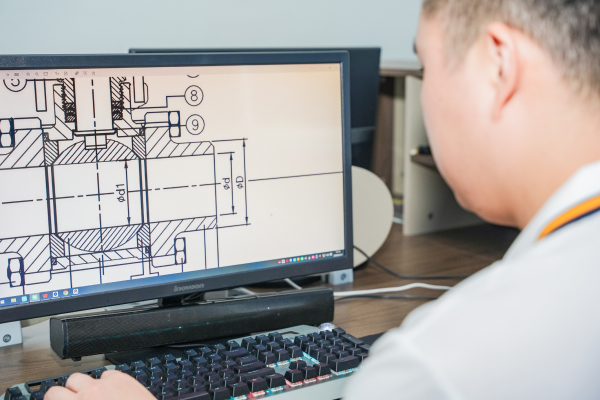
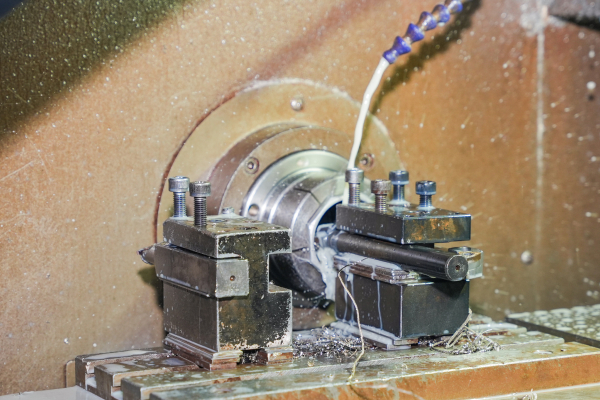
- Use high-precision CNC machining for thread cutting, rather than manual or low-precision equipment
- Perform go/no-go thread gauge inspection on every fitting, catching dimensional deviations before shipment
- Verify raw material composition through spectral analysis, ensuring the stated grade (304, 316, or 2205) is accurate
- Support custom threading and non-standard specifications, including custom bore sizes, flange dimensions, and surface treatments for project-specific requirements
Choosing the Right Fitting for Your Project
A practical decision framework:
- Choose threaded fittings when: installation speed matters, the system may need future maintenance access, and pipe diameters are in the small-to-medium range
- Choose welded fittings when: the application involves high pressure, high vibration, or larger diameters where a permanent, seamless joint is preferred
- Mix both where appropriate: many real-world systems use welded fittings for main distribution lines and threaded fittings for branch connections and equipment hookups that require periodic access
Sourcing Considerations
For distributors and engineering firms sourcing pipe fittings at scale, consistency across large orders is often more important than any single spec sheet. Key questions to ask a fitting supplier:
- What is your minimum order quantity, and does it vary by fitting type or size?
- Can you support non-standard bore sizes, flange dimensions, or surface treatments?
- What is your standard lead time, and do you offer expedited production for urgent projects?
- Do you offer full traceability from raw material batch to finished fitting?
Final Thoughts
Threaded and welded fittings each solve different problems — speed and maintainability versus strength and permanence. The right choice depends on pressure requirements, pipe diameter, and how often the system will need to be serviced. Whichever method fits your project, insist on verified material composition and precision-machined threads or welds, since a fitting is only as reliable as the process that made it.